
The Women's Reservation Act 2023, mandating 33 per cent quota for women in legislatures, has been enacted, but its immediate implementation is unclear due to ongoing parliamentary debates and delimitation requirements.

The Centre has notified the implementation of the Women's Reservation Act 2023, providing a 33 per cent quota for women in legislatures, Jammu and Kashmir, and Union Territories, with the provisions set to come into force on April 17, 2026.

Prime Minister Narendra Modi is advocating for the implementation of the Women's Reservation Act by the 2029 Lok Sabha elections and Assembly elections, urging all members of Parliament to support amendments to the Nari Shakti Vandan Adhiniyam during a special session.

Prime Minister Narendra Modi announced that Parliament is on the verge of creating 'new history' by amending the Women's Reservation Act this week, ensuring its implementation by 2029. He highlighted the unanimous passage of the law in 2023 and the collective demand for its early enforcement.

Sonia Gandhi criticises the government's proposed delimitation, claiming it's a politically motivated move to delay the caste census and gain an unfair advantage, rather than genuinely promoting women's reservation.

The BJP and opposition parties are engaged in a political battle over the implementation of the Women's Reservation Act, with the BJP defending it as historic and the opposition accusing the government of delaying its notification and using it to push an unconstitutional delimitation exercise.

A bill to implement 33 per cent reservation for women in Lok Sabha and state assemblies by increasing the lower house's strength to 850 is slated for introduction in Parliament. The bill seeks to amend Article 81 of the Constitution and utilise 2011 Census data for redrawing constituencies.

The government has released a set of FAQs to address concerns and clarify the details surrounding the Women's Reservation Bill, which aims to provide 33 per cent quota for women in legislatures.

Opposition members in the Lok Sabha have questioned the government's decision to move a bill to amend the 2023 women's quota law before bringing the principal Act into force.

Several opposition parties on Wednesday decided to jointly oppose the delimitation provisions in the Constitution amendment bill in Parliament, even as they reiterated support for women's reservation, with Mallikarjun Kharge alleging the move is politically motivated.

With the three-day special sitting of Parliament on the constitution amendment bill related to the implementation of 33 percent reservation for women from the 2029 Lok Sabha polls set to begin on Thursday, a meeting of opposition parties is slated to be held on Wednesday at the residence of Congress president Mallikarjun Kharge.

West Bengal Chief Minister Mamata Banerjee has accused Prime Minister Narendra Modi of misleading the nation regarding the women's quota bill and plotting to push through the delimitation exercise by using women as a shield.

Rahul Gandhi accuses the government of using the women's reservation bill as a smokescreen to manipulate India's electoral map and diminish representation for certain states.

A Constitution Amendment Bill aimed at implementing 33 per cent reservation for women in legislatures and increasing Lok Sabha seats was defeated in Parliament, marking a setback for the government's efforts to empower women in politics.
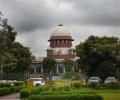
The Supreme Court has sought the Centre's response on a plea seeking the implementation of the 2023 Nari Shakti Vandan Act, which reserves one-third of seats for women in the Lok Sabha and state assemblies.

The Indian Parliament is expected to extend its budget session to introduce a bill increasing Lok Sabha seats to 816, reserving 273 for women, and amending the women's reservation law.

Opposition leaders have criticised Prime Minister Narendra Modi's address to the nation, calling it politically motivated and a misuse of official platforms during ongoing elections.

The Indian government and opposition parties are set for a showdown in Parliament over a Constitution amendment bill concerning the implementation of the women's quota law and the delimitation exercise. The Opposition is concerned about the potential impact of delimitation on the political representation of southern states.

'The Supreme Court stated that once the delimitation plan is approved by Parliament and receives assent of the President, it cannot be undone. Nor can it be modified.'

What is missing in the BJP's armour is dominance over 50 percent of the electorate: Women. And this is a gamble Modi-Shah have indicated that they are willing to take, explains Saisuresh Sivaswamy.

'The reason why they rushed through the bill was they wanted to avoid using the 2026 Census because the 2026 Census by their own decision will be a caste census.' 'The BJP knows that a significant share of the OBCs who will get captured in the census, for the first time after the 1931 Census, are against the BJP. Only a segment of the OBCs are in their favour.' 'So they wanted to avoid the OBC reservation among women, which is a demand of a lot of Opposition parties.'
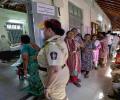
Votes will be counted on January 16 and the outcome will be keenly watched as the BJP-led Mahayuti will seek to stamp its supremacy in urban landscape, especially in Mumbai, while the Opposition parties will try to redeem themselves after last year's rout in assembly polls.

Initiating the debate on the bill from the opposition's side, Congress leader Sonia Gandhi said that any delay in bringing the reservation into effect would be "gross injustice" to Indian women.

This Women's Day Week, we celebrate the groundbreaking achievements of Justice Anna Chandy, Justice M Fathima Beevi and Justice Leila Seth.

Besides the bills, the government has listed the first batch of supplementary demands for grants for 2023-24 for presentation, discussion and voting during the session.
The next Census' findings will help identify the extent of India's ageing population and vulnerability levels.

A bench of Justices SK Kaul and Sudhanshu Dhulia said the Centre cannot preclude reservation from being extended to women in civic bodies by saying it doesn't apply to tribal areas.

Experts say the state's economy is grappling with hidden debt, rising welfare costs, and lack of transparency.

The youngest in the CWC is 31-year-old Neeraj Kundan, who is an ex-officio member of the body as the president of the National Students Union of India, the students' wing of the party.

'The upper caste elite's belief that they are casteless is a belief that is available only to the upper castes. Because all the lower castes are reminded by society every day what their caste is.'
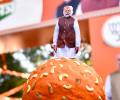
Delhi faces a severe financial crunch and the deficit is largely due to numerous welfare schemes without adequate revenue flowing in. The success of welfare schemes and electoral promises will need careful financial planning and out of the box thinking to whip up additional revenue, notes Ramesh Menon.

A day after AFSPA was extended in most parts of Manipur, rights activist Irom Sharmila said the "oppressive law" was not a solution to the conflict in the state.
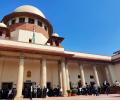
The apex court observed that it respects the local sentiments but asserted authorities cannot let the law of the land not prevail especially when there is nothing affecting the personal rights or personal laws.

The Republic Day parade, which will begin at around 1030 am, will be a unique mix of the country's military prowess and cultural diversity, depicting the country's growing indigenous capabilities, Nari Shakti and emergence of a 'New India'.

"Last time I stood, I was not allowed to speak. The ruling party paid a very heavy price for throttling the voice of one MP," she said, referring to her suspension in the last session.

'In the long run, I don't foresee major ramifications [about Trudeau's allegations].' 'There's just enough hypocrisy among Western nations for India to douse the outrage.'

Kavitha Kalvakuntla, 44, a Bharat Rashtra Samiti MLC, declared this in a late-night post on her official Twitter handle.

Kavitha said 'these tactics of intimidation' against the fight of her father and Chief Minister K Chandrasekhar Rao and the BRS would not deter them.
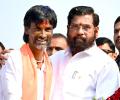
'The BJP, already falling short of a strong OBC leader from Maharashtra, will be more than happy to welcome Chhagan Bhujbal in its fold.'
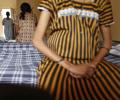
A plea has been filed in the Supreme Court challenging the rules issued by the Union health ministry which prohibit donor gametes to couples desirous of having children through surrogacy on the ground that it frustrates the provisions of the Surrogacy (Regulation) Act, 2021, which gives the right of parenthood to infertile couples.
